

The Extreme Light Infrastructure ERIC (ELI) has launched 4U-PI (Ultrafast, Ultrashort, Ultrahigh-peak-flux, and Ultrahigh-dose-rate particle sources driven by high-intensity lasers), a flagship four-year European initiative funded under Horizon Europe. The project enhances Europe’s global leadership in laser–plasma particle acceleration and accelerates its practical application in medicine, industry, and emerging technologies.
Real-world Impact
The primary goal of 4U-PI is to address critical societal and technology needs by driving scientific innovation from real application requirements. The scientific impact extends across multiple disciplines from medicine to fusion energy.
The project will support research in ultrafast radiobiology, FLASH radiotherapy, medical isotope production, advanced imaging, homeland security and fusion-related materials research. At the same time, standardised experimental protocols and validated workflows will help move emerging technologies closer to practical deployment in research and industrial environments.
“4U-PI has all the essential ingredients for a successful European research project: a strong scientific and technological case, a consortium of partners that brings together complementary expertise in lasers, particle acceleration, diagnostics and applications and a genuinely collaborative working environment,” says Daniele Margarone, ELI Beamlines Science Director and 4U-PI Project Coordinator. “This foundation will help us advance laser-driven particle sources and bring them closer to real use in medicine, industry and energy research.”
Pioneering Next-Generation Radiation Tools
4U-PI is a project funded by Horizon Europe Research and Innovation Action with a total EU contribution of EUR 10 million designed to advance the next generation of laser-driven ion and neutron sources. Bringing together 12 partners from six countries, the project combines the capabilities of all three ELI Facilities, FAIR, GSI, HZDR, CLF-UKRI, and industrial partners to accelerate the transition of laser-plasma technologies from laboratory demonstrations to user-oriented research platforms.
The initiative addresses a key challenge in high-intensity laser science: developing particle and radiation sources that are reliable, reproducible and accessible to a broad scientific community. By advancing high-repetition-rate ion sources, hybrid acceleration schemes, compact beam transport systems, diagnostics, dosimetry and AI-assisted optimisation tools, 4U-PI aims to establish new standards for laser-driven particle acceleration and secondary radiation generation.
A Hub for Collaboration at ELI
For ELI, 4U-PI reinforces its role as a testbed for advanced secondary sources and user-driven experimentation. Across the ELI Facilities, the project will deliver upgraded ion and neutron platforms, enhanced diagnostics and dosimetry capabilities and new experimental tools supporting applications in medicine, imaging and high-energy-density science.
Together, these activities position 4U-PI as both an essential scientific initiative and a key strategic investment in Europe’s future capabilities in accelerator science, biomedical research, advanced imaging and laser-driven technologies.
Kick-Off Meeting
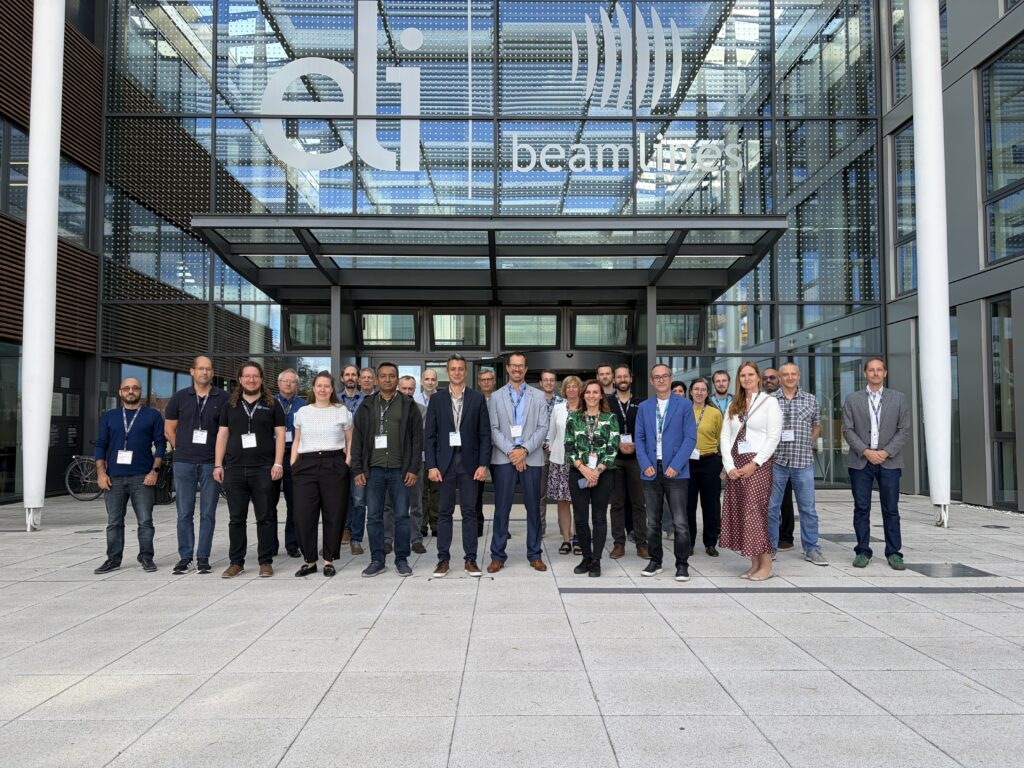
The 4U-PI Kick-Off Meeting, on 15-16 September 2026, officially launched the project. The two-day event brought together international scientific leaders, industrial partners, and stakeholders to align work packages, establish standardised dosimetry protocols, and outline the immediate milestones for the initial phase of the project.
About ELI
The Extreme Light Infrastructure ERIC (ELI) is the world’s largest and most advanced high-power laser research infrastructure. ELI operates state-of-the-art research facilities in Dolní Břežany (Czech Republic) and Szeged (Hungary), providing the global scientific community with access to unprecedented laser intensities and ultrashort secondary particle and radiation sources.