


The L3 HAPLS laser system at the Extreme Light Infrastructure ERIC (ELI) has reached a peak power of 0.95 petawatts, delivering 26.6 J in 28 fs during its ongoing commissioning ramp-up. The result exceeded the performance expected at this stage of the campaign and marks a major operational milestone on the system’s path to full design specification.
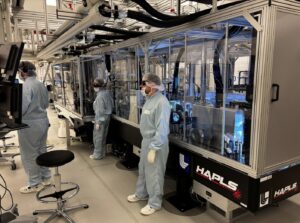
The achievement is the result of a long-term collaboration between ELI and Lawrence Livermore National Laboratory (LLNL), building on years of joint expertise in high-power laser technology. Following the installation of the L3 HAPLS laser system at ELI, experts from both institutions have worked to safely and systematically increase the laser’s performance toward its design parameters.
The key challenge has been the performance of specific optical components operating at high laser intensities and the energy ramp-up of the high-power short-pulse amplifier. Operating at such high intensities requires a careful balance between maximising the laser performance and resistance of highly exposed optical components. To achieve this, the joint team carried out extensive analysis of the results obtained in the previous phase and performed numerical simulations, which led to optimisation of specific optical subsystems and suggested other improvements. The achieved results confirm the analysis predictions and demonstrate the potential of the used laser technology as well as successful strategy of the performance ramping.
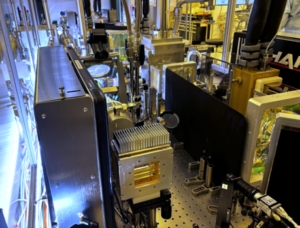
“Achieving nearly a petawatt confirms that the laser can be pushed toward its design performance safely and predictably,” says Roman Hvězda, Facility Director of ELI Beamlines. “This is a critical step before the system can be operated routinely at full power for experiments.”
The next steps will focus on further increasing the nominal peak power to petawatt and beyond, and simultaneously achieving the repetition rate first 3.3 Hz and beyond. These operating conditions will significantly increase the scientific throughput of the facility, enabling demanding experimental campaigns requiring both extreme peak power and high average data rates.
Currently, L3 HAPLS is one of the most utilised laser systems within ELI’s User Programme, simultaneously serving three experimental stations. Its unique combination of peak power, stability, high reliability, and repetition rate, supports a wide variety of user experiments.
The laser supports a broad range of research, including laser-driven acceleration of ultrashort particle bunches, brilliant hard X-ray generation, high-energy-density physics, radiobiology, and advanced materials research. These capabilities enable developments in medical imaging, industrial diagnostics, cultural heritage studies, energy research, and security applications.
The continued commissioning of L3 HAPLS advances laser technology and further expands ELI’s capabilities as an international user facility for high-field and high-energy-density science.