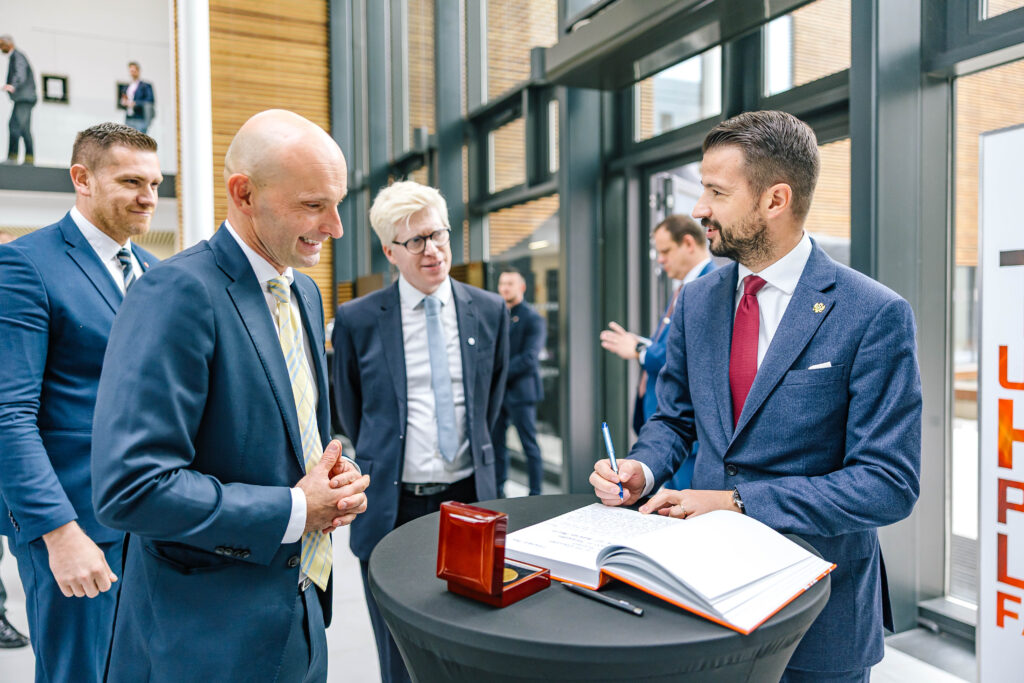


Presidential visit highlights scientific cooperation and a new agreement establishing a framework for long-term collaboration between the University of Montenegro and ELI.
Dolní Břežany, Czech Republic – 4 November 2026
The President of Montenegro, Jakov Milatović, visited the Extreme Light Infrastructure ERIC (ELI) today as part of the official state visit to the Czech Republic. The visit highlighted Montenegro’s growing scientific engagement with ELI and followed the signing of a collaboration agreement between ELI and the University of Montenegro.

The agreement, signed on 3 November at Prague Castle, establishes a framework for scientific and educational cooperation, including joint research, researcher and student mobility, training activities, joint publications and future grant applications. It was signed by Florian Gliksohn, Interim Director General of ELI, and Prof. Dr. Svetlana Perović, Vice Rector of the University of Montenegro.
“Montenegro has developed a strong relationship with ELI through its scientific community, and this agreement puts in place a foundation to build on,” said Florian Gliksohn, Interim Director General of ELI. “We welcome Montenegro’s ambition to expand its participation in ELI and contribute to European laser science.”
In March 2026, Montenegro became an Observer in ELI. Observer status provides a structured platform for participation in ELI programmes, support for researcher and student mobility, and closer involvement in the governance and activities of the Consortium. It also enables Montenegro to assess a future pathway towards full membership.
Through sustained involvement in ELI’s User Programme, Montenegrin researchers have strengthened scientific capacity, built institutional links and connected with research groups across Europe. By providing access to advanced laser systems for scientists from Europe and beyond, ELI serves as a hub and a direct route into international scientific cooperation.
A growing scientific partnership
Montenegro’s engagement with ELI is supported by a committed and active research community, particularly research teams from the University of Montenegro working on advanced semiconductor detectors and radiation-detection technologies.
Since 2022, Montenegrin researchers have carried out nine experiments at ELI, contributed to 19 international journal articles and involved seven students in onsite research. Their work has focused on the development of advanced semiconductor detectors, relevant to high-energy physics and radiation detection.
Building on this work, the agreement opens opportunities for cooperation in additional fields, including laser-driven ion beams and their medical, biological and space applications; ultrafast radiation biology; radiation-hard detector development; laser-induced fusion; and the non-destructive investigation of cultural heritage materials.
“Our cooperation with ELI has already produced tangible scientific results and connected Montenegrin researchers with a wider European network,” said Prof. Dr. Svetlana Perović, Vice Rector of the University of Montenegro. “The agreement opens new opportunities for our students, researchers and institutions, and provides a basis for expanding this partnership in the coming years.”
During the visit, President Milatović was introduced to ELI and its mission, met representatives of the Montenegrin scientific community and toured the ELI Beamlines Facility, including its experimental areas and laboratories.
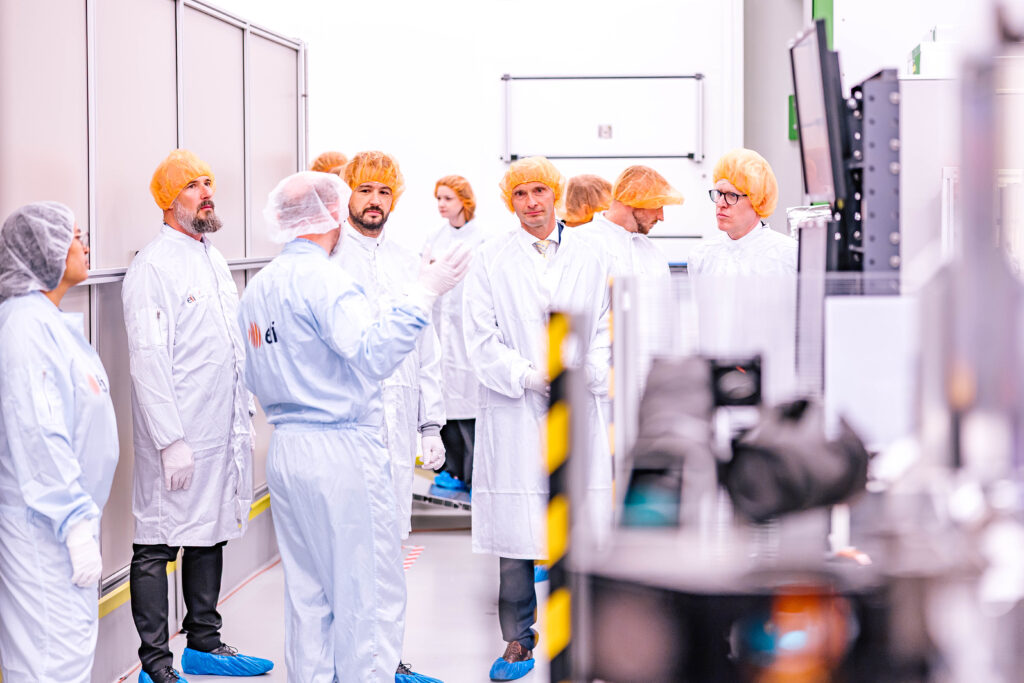
The visit brought together Montenegrin political representatives and scientists at the facility where the research is carried out, creating an opportunity to discuss scientific cooperation in a practical setting. It also underlined the importance of creating the conditions for researchers to continue developing their work and contributing to scientific progress both internationally and in Montenegro.
The Extreme Light Infrastructure ERIC (ELI) is the world’s leading laser-based research infrastructure. The international user facility dedicated to multi-disciplinary science and research applications provides access to high-power, high-repetition-rate laser systems. ELI operates as a single multi-site organisation with complementary facilities specialised in different fields of research with extreme light: ELI Beamlines in the Czech Republic, focused on high-energy beams, and ELI ALPS in Hungary, specialising in attosecond light pulses.